Design
Why is this work important?
The frequency and severity of climate events such as floods, droughts, and rising sea levels are worsening due to climate change. Such events cause sanitation technology to fail and result in health risks and environmental pollution. These effects are particularly pronounced in urban and peri urban areas in low to middle income countries. It is essential to integrate climate resilience into the design of sanitation technology to mitigate these risks.
Method
As a member of UTS' Institute for Sustainable Futures (ISF) research team, this work involved a comprehensive literature review of academic and non-academic sources. Literature was analysed for: 1) aspects of climate hazards that impact sanitation (for example, sediment transported by floodwaters can block pipes) and 2) design features that support resilience. Both the hazards and the features were then used to construct a framework to assess the resilience of sanitation technology. ISF was funded by the Bill and Melinda Gates Foundation for this work.
Findings
The following 26 design features that support resilience were defined, these were resolved into 7 categories (shown as A to G below).
A. Avoiding exposure to hazards
1. Raising
2. Burying
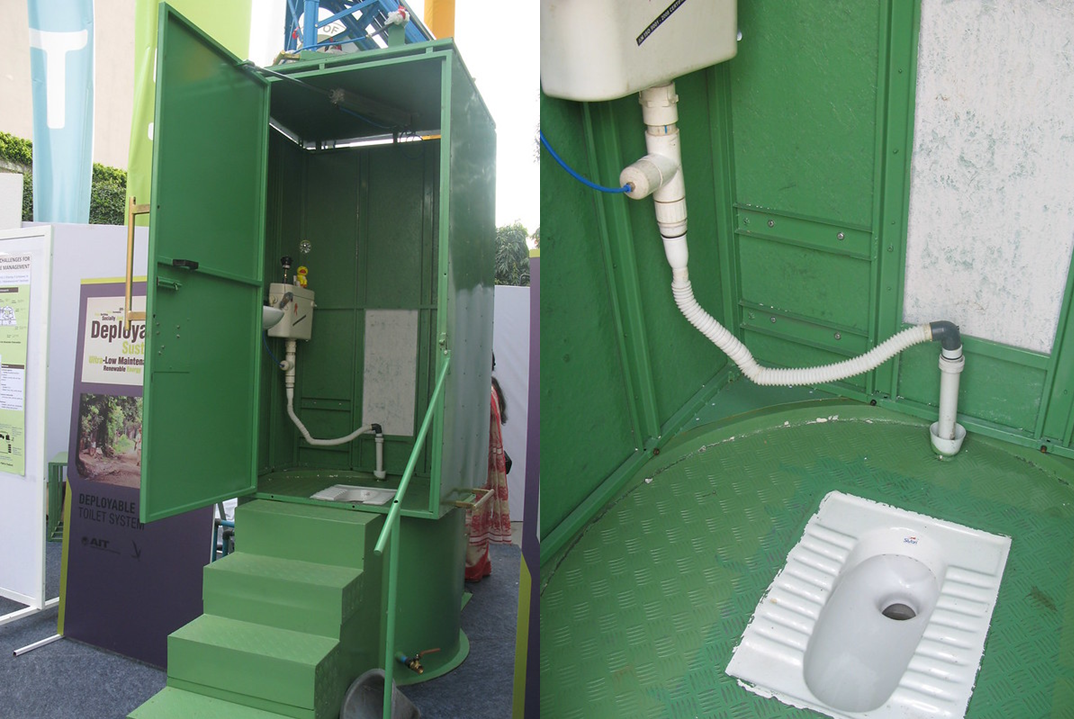
3. Portability
4. No/low Inputs
B. Withstanding exposure to hazards
5. Armouring and strengthening
6. Oversizing
7. Shapes that distribute pressure
8. Circumvention
9. Sealing and Barriers
C. Enabling flexibility
10. Adaptability
11. Modular design
12. Platform design
13. Redundancy and diversity
14. Signalling
D. Containing failures
15. Frangibility
16. Fail-operational
17. Decentralisation
E. Limiting consequences of complete failure
18. Safe disposal
19. Reusable materials
20. Fail-silence
F. Facilitating fast recovery
21. Repair speed
22. Accessibility for rapid flaw detection & repair
23. Rapid deployment
G. Providing benefits beyond sanitation technology resilience
24. Reciprocity
25. Hybridising
26. Transformative capacity
Definitions and examples of each feature were drawn from literature or developed by the research team. For example, ‘portability’, refers to a ST’s ability to avoid climate hazards through relocation; and ‘low/no inputs’, a ST feature that reduces its exposure to climate-driven disruption of water and electricity inputs.
The framework can assist sanitation implementers and designers to: self-assess if and how a sanitation design incorporates the resilience design features; assess the vulnerability of sanitation to climate hazards; and prompts sanitation developers to consider ways to re-design the technology, so that it will function over the long-term even with worsened climate hazards. These features and the framework may also be useful for other types of infrastructure.
Want to learn more?
To learn more about the framework, contact the Institute for Sustainable Futures at the University of Technology Sydney. If you're interested in learning how to integrate resilience into your project work, or develop bottom-up approaches to resilience, please contact us at Small is Beautiful.
Photo credits: Image from SuSanA Secretariat (FlickR Album) reproduced under Creative Commons Attribution (CC BY 2.0)